Blackpink Ddu-du-ddu-du
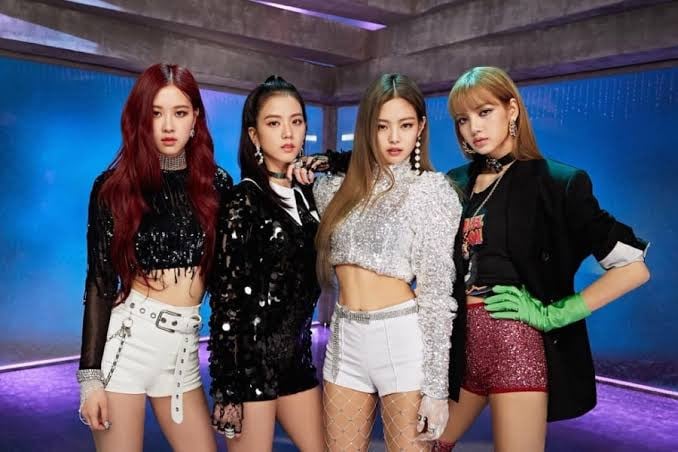
From left to right: Rose, Jisoo, Jennie and Lisa
- In one of the first scenes, Jennie is filmed sitting down on a raised podium. The mise-en-scene of her costume shows her in a crown. This creates the narrative that she is a ruler, and therefore subverts the idea that women are weak, by positioning her in a powerful manner.
- Jennie's verse opens with the line 'A kind face and an attitude that isn't', this goes against the stereotypical presumption of society that all women are kind.
- The next scene shows Lisa. The mise-en-scene of Lisa's costume, which includes trousers, subverts the stereotypical conventions expected of a girl-group music video, particularly K-Pop, because it is not related to femininity.
- The mise-en-scne of her prop, which is a katana, creates the narrative that she is a strong and powerful individual. The camera-angle is straight-on during most of this scene, further illustrating Lisa as a powerful individual, because the viewer is forced to look at her holding the weapon, as she is the main focus of the scene.
- During one scene, there is a low-camera angle when Lisa is walking across, this positions the audience below her, further strengthening the idea of superiority.
- In the next scene Rose is filmed within the setting of a church, the mise-en-scene of her all-white costume is symbolic coding for being an angel. This presents Rose as powerful, as it creates the narrative that she has other-worldly strength. This subverts the representation of women in media, as it presents her as strong and powerful.
- The camera-angle when Rose is stood up on the podium is low, this creates the narrative that she is above them, and assigns a sense of superiority to her. By also showing Rose as higher than others, and wearing clothing associated with religion, she could be representative of God, which subverts assumed gender roles.
- Rose also says, "I only smile easily for myself." The lexis of the word, "myself", suggests that she does not need a man to make her happy.
- The choreography includes gun-shot movements, incorporating the theme of violence into the music video. This is unexpected and subverts the stereotypical conventions of a girl-group music video.
- The next scene pictures Jennie on a tank, which carries on the theme of violence. It subverts the idea that women should not be in the army, by showing her on top and exposed to danger. This assigns her powerful and strong qualities.
- This theme is further continued in the following scene, where Jisoo is faced with phones acting as symbolic coding for guns. This creates the herementic code that she will be shot, but the mise-en-scene of her expression is seemingly unconcerned. This presents Jisoo as a strong character who is not afraid of guns, and creates the narrative that she is the hero opposed to the typical damsel in distress many women in media are depicted as.
- In Rose's next scene, she is swinging from a chandelier. A chandelier is expensive. This suggests that Rose is rebellious. It could also suggest that she does not care if she breaks the chandelier because she can afford to pay for the damage. This presents Rose as rebellious and rich, whereas men are normally presented in this way.
- In Rose's final solo scene, she walks through a set of hanging pink flowers, whilst dressed in a pink-red dress, with red-hair. The inclusion of pink flowers highlights femininity, and presents women in a stereotypical way of loving this colour. Previously in the music video, Jisoo has been filmed with pink hair, Lisa with a pink suit and Jennie with pink popcorn. This shows that girls can still be powerful, without having to completely change their identity and admiration for the things they love.
- The symbolic coding of Rose's red hair and red dress, connotes the idea of love and passion, and presents her to an attractive hegemonic standard. The dress however is not revealing and covers her body, so she is not overly objectified and sexualised. This presents the ideological perspective of the producer, that women can still be attractive without needing to reveal a lot.
- The music video ends with all four girls sat on the podium, staring directly into the camera at a mid/far-shot camera position, with a staight-on angle. Because Blackpink's target audience is mostly young girls, this could be to show that everyone can be on the same level as them, and being a powerful female is achievable.
Overall:

- Blackpink are presenting the ideological perspective that women can be powerful, and can achieve this by showcasing their authority, and without changing themselves as people.
- Women are attractive, and do not need the help of a man in order to be seen as so. They can dress in any clothing, which subverts the dominant ideology of society, that women need to dress in revealing or feminine clothing in order to be seen as attractive to a hegemonic standard.
- They subvert the conventions of a girl-group, particularly in K-Pop. They sometimes wear trousers and masculine-associated clothing.
Si Tu Gagnes Au Flipper - Chantal Goya
- This music video is in black and white, this is representative of the time period in which it was produced.
- This music video has low production standards, as can be recognised through the use of repetitive scenes (the same videos playing on loop). Nowadays music videos consist of multiple scenes with different things happening within each one, this shows genre fluidity as standards have progressed over time
- The singer, Chantal Goya's face is the only part of her which is filmed. This shows there was more of a focus on the music and the singer opposed to body and over-sexualisation, which has become a saturated part of the music video industry over the past few years.
- She is arguably also not the main focus, the video is edited with her in a small box at the side of the ongoing scenes. This shows there was more of an emphasis on setting rather than the appearance of the singer.
- The video is badly edited to today's standards, yet is probably revolutionary of the time, with all of the transitions consisting of the fade in/out movement.
Rebecca - Vanity Angel
- The use of green-screens displaying various bright images, creates a chaotic meaning for the audience, presenting a sense of wildness.
- The mise-en-scene of the umbrella? prop, looks useless because it has many gaps within it. This further strengthens the unconventional tone and contributes to the wildness and chaotic theme the video is presenting.
- All of the props are colourful, such as the table and the karaoke machine, using a neon colour pallet.
- I think this video is trying to construct the meaning, that by being yourself and unconventional you will be happier and more confident. Being wild and free is the way to go.
Hand on Your Heart - Kylie Minogue
- Women are sexually attractive, this meaning is anchored by the symbolic coding of the mise-en-scene, which includes the colour red. In one scene, Kylie is pictured in a tight, red dress whilst surrounded by a setting which incorporates a colour pallet based around this colour. This helps to highlight the meaning behind the video.
- This is further reinforced through the mise-en-scene of various statues and paintings, which all include depictions of women who are attractive to a hegemonic standard. This helps to compare women to art, further proving their attractiveness.
- The mise-en-scene of the multi-coloured podiums remind me of a circus, so this could suggest that women are fun to be around because of their attractiveness.
Pulp - This is hardcore
- There is a binary opposition between the woman wearing white, and laying in bed. Her clothing is suggestive, and implies other things have occurred, yet she remains in white which acts as symbolic coding for purity.
- There is a scene where the woman offers a man a cherry to eat. The proairetic coding of the cherry could imply multiple things are going to happen. It is polysemic, and could be taken in different ways dependent on your age.
- I read the comment section of this video, and it appears this video is very polysemic with regards to it's overall meaning. One user suggested that the video's meaning is anchored by the lyrics, which create the narrative that... "If you really listen and understand the lyrics, this song is clearly about sex and porn. About a man who only experienced porn in his life and losing his virginity. Its a pretty brilliant song if you ask me.", Whilst another person suggested that "Weird. I've always heard it as a guy who's in a marriage that's lost its "spark" trying to talk his wife into rekindling that old flame by talking all sexy. I guess art can be interpreted in multiple ways."
- The mise-en-scene of the man being tied up whilst the woman looks at him, could also be symbolic coding, implying something else. But then again, this is all polysemic. I more see it for the story, but the way she looks at him is suggestive.
Satisfaction
- Very overly-sexualised presentation of women. The close-up shots of their body-areas such as their breasts, shows the only focus should be on a woman's body.
- This related to Lisbet Van Zoonen's feminist theory, that women are only constructed within a media product to attract heterosexual men
- The mise-en-scene of their costumes are revealing, such as short-shorts and very cropped tops/bikini tops. This further objectifies the women and focalises only on their bodies.
- There are multiple close-up shots on the women's mouths, which displays symbolic coding of the colour red, suggesting that they are sexually attractive due to the connotations of this colour.
KPP - PonPonPon
- KPP is constructed as a star, due to her appearance. The mise-en-scene of her costume incorporates Lolita fashion, which is common in Japan for being outrageous and bold. This creates the narrative that KPP has the confidence to wear clothing, and therefore she is someone to look at as she boasts star quality.
- The mise-en-scene of her microphone suggests that she is a singer, and anchors her star-power and fame to being because she can sing. This is further highlighted by the inclusion of choreography, which shows that she is prepared and organised like a celebrity would be.
- The inclusion of multiple effects, for example, the eyeballs coming out of her mouth being added in - shows that this piece had high production values. Because a lot of money was invested into this, it can be expected that she is a celebrity, or at least boasts some importance.
TERMS:
Star appeal - where a performer has been constructed so distinctively, she generates audience adoration and her appeal goes beyond that of just being a 'performer'
Hypersexualisation - literally 'beyond sexualisation', hypersexualisation is an extreme version of sexualisation, which aims to make it clear to the audience that it's sole purpose is to provide sexual gratification.
Bricolage - where a media product is constructed from a range of elements, often from completely different contexts and time periods
Generic Fluidity - the way in which a form or genre changes over time
One thing to make completely clear is that a music video is not 'the product'... it is an advert for a product! Music videos are, in general, freely accessible and viewed for free. While in the UK, we tend to call them music videos, in America they tend to be referred to as promos, and in Japan as PV/PMVs (promotional (music) videos). So, by and large, the world is pretty honest about their status as an advert!
Comments
Post a Comment